
Rosa Meier · 25 September 2026
Hainlyn Stargazing Advocates Seek Tighter Controls on Neighborhood Lighting
Local astronomy clubs and residents in Hainlyn have formed coalitions to address rising light pollution that interferes with celestial observations, and their efforts gained momentum through a series of public meetings held in September 2026. These groups collect data on sky brightness levels across residential districts, documenting how streetlights, porch fixtures, and security lamps scatter upward and wash out stars. Researchers note that measurements taken over the past year show increases in artificial skyglow by as much as 18 percent in several neighborhoods.Understanding the Scale of the Problem
Data from portable sky quality meters deployed by volunteers reveal that many residential zones now register readings above 20.5 magnitudes per square arcsecond, a threshold that limits visibility of fainter stars and planets. Observers point to unshielded fixtures on private properties as a primary contributor, since these direct light horizontally and upward rather than downward onto intended surfaces. Studies conducted by European environmental agencies indicate similar patterns across mid-sized towns where residential expansion outpaces updates to lighting standards.
Residents who participate in monthly star parties report that once-clear views of the Milky Way have become intermittent, especially during summer months when outdoor lighting use peaks. Equipment logs kept by the Hainlyn Astronomical Society show that telescope sessions now require additional filters to compensate for background glow, adding time and cost to routine observations. The pattern holds across multiple districts, with newer subdivisions showing the highest readings because of widespread installation of bright LED floodlights.
Organized Efforts and Data Collection
Coalition members have compiled maps that overlay light measurements with residential zoning boundaries, highlighting clusters where complaints about visibility have risen. These maps get shared with municipal planners during open forums, and they include photographs of specific fixtures identified as major contributors. In September 2026 the group presented updated readings collected from 47 locations, demonstrating consistent upward trends since the previous winter.
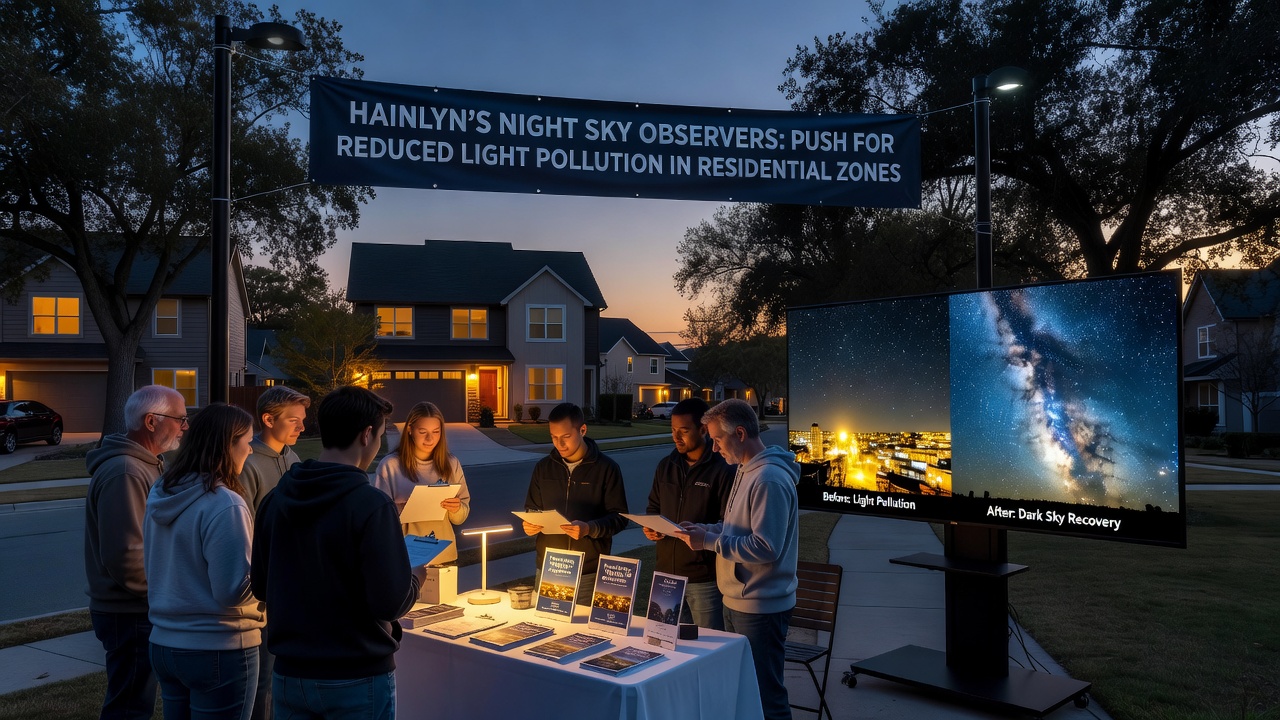
Participants also distribute informational packets that explain how full-cutoff fixtures reduce waste while maintaining safety, and they cite examples from other municipalities that adopted similar changes. One neighborhood association installed shielded replacements on a trial block and recorded a measurable drop in sky brightness within three months. Such case studies get referenced during discussions with homeowners who remain uncertain about switching equipment.
Regulatory Context and Next Steps
Current residential lighting codes in the area focus mainly on minimum illumination levels for safety, without explicit limits on upward light spill. Advocates propose amendments that would require shielding on new installations and encourage retrofits through rebate programs. Figures released by regional planning offices show that residential permits for outdoor lighting have increased 22 percent over five years, underscoring the need for updated guidelines.
International resources such as those provided by the International Dark-Sky Association offer model ordinances that communities elsewhere have adapted successfully. A separate report from Canadian researchers at the University of Alberta links reduced light pollution to lower energy consumption and improved nocturnal wildlife corridors. Local groups reference these documents when meeting with council members to discuss feasible policy adjustments.
Conclusion
Continued monitoring by Hainlyn observers supplies ongoing data that tracks whether new lighting practices produce measurable improvements in sky quality. The coalition plans additional measurement campaigns through the coming winter to establish baseline comparisons before any code changes take effect. Their records remain available to planners and residents who want to review the evidence directly.